
MECHANICAL HARVESTING
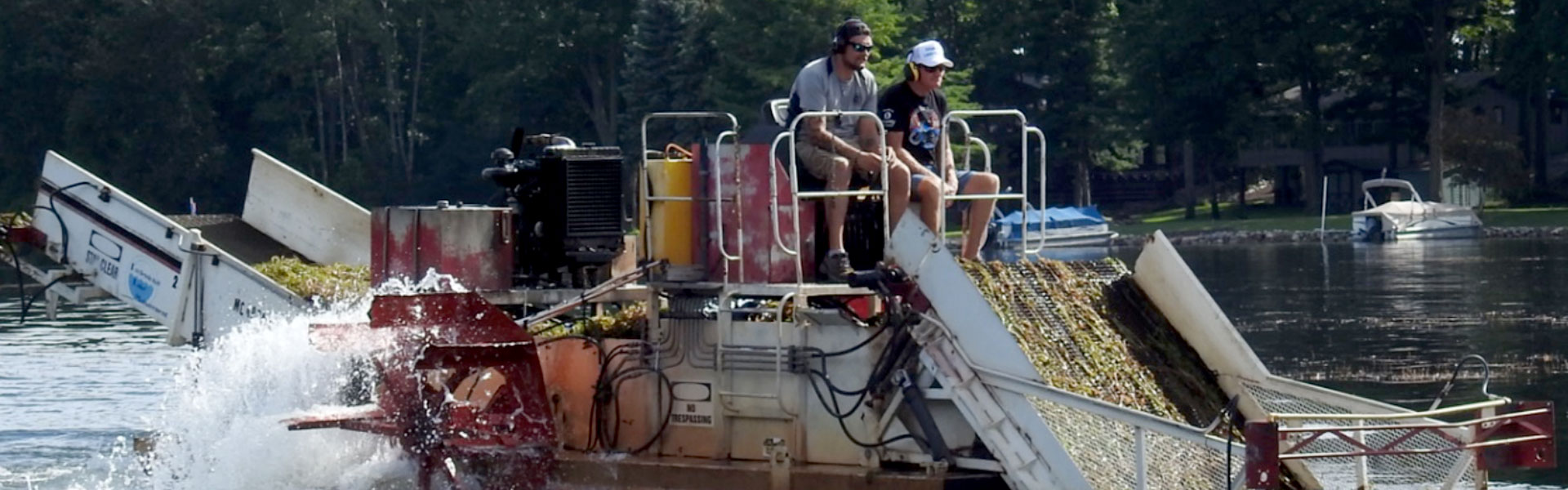
We would like to give you some information on a large piece of equipment you may notice on our lakes. A Mechanical Harvester is an effective and environmentally friendly management strategy used for removing excessive aquatic plants from waterbodies.
Why utilize Mechanical Harvesting?
We were very successful in containing and vastly reducing the amount of milfoil (an aquatic invasive species) over the last few years in Lake Lancelot. The lack of milfoil and this year’s water and weather conditions allowed the native species to grow and prosper, creating too much of a good thing. These native species (long leaf pond weed and wild celery) are very important in the health of our lakes and create an excellent environment for fish and wildlife (loons).
It is for these reasons the DNR strictly controls the use of herbicides on native species. A harvester can reduce the cover and the dense vegetation of native plants, clearing the top 4-5 feet of water enhancing recreational use and increasing water flow. This selective harvesting gives us the ability to manage habitat structure for fisheries or other wildlife without significantly altering the natural vegetative environment.
How does the mechanical harvester work?
The harvesting machine has vertical and horizontal sickle-bar cutters that shear off the plants to a maximum depth of about five feet. Cut plants are collected and conveyed onboard the harvester to be deposited onshore, drained, and removed to an authorized disposal location.
What are the pros and cons of mechanical harvesting?
- Offers an eco-friendly solution that does not create temporary water use restrictions during or after the work.
- Acts as an alternative in situations where herbicides are not appropriate or desired.
- Removes plant biomass from the waterbody – reduces silt build-up.
- Provides area selective control of nuisance species.
- Enhances the effectiveness of aquatic vegetation control when combined with other control strategies.
- Must be contracted out to professional services at additional costs.
- Cannot be used with invasive species since cutting will allow species to rapidly reproduce.
- Cuttings can collect in the water from winds and currents and will have to be raked from beaches and shorelines.
What can lakefront homeowners do?
- Rake the waters around your dock area and swim areas to remove unwanted vegetation.
- Rake your shoreline and water to keep them free of dead weeds, cuttings, and leaves.
- Place all removed vegetation at curbside for POA pickup (on Mondays and Fridays).
In summary, inspect and clean your boat prop often! Our lakes are Sugar Springs most important amenity and mechanical harvesting is another tool to assist us in properly managing our watershed.
Your Lakes Committee
We would like to thank Solitude Lake Management for contributing information in this document. For further information click on their link.
The Lakes Committee is dedicated to Environmental Sustainability which is the responsibility to conserve natural resources and protect our ecosystems to support health and wellbeing, now and in the future. Looking beyond the waters of our lakes in Sugar Springs, the ecosystem is vast, and all Sugar Springs members can have a positive influence.